
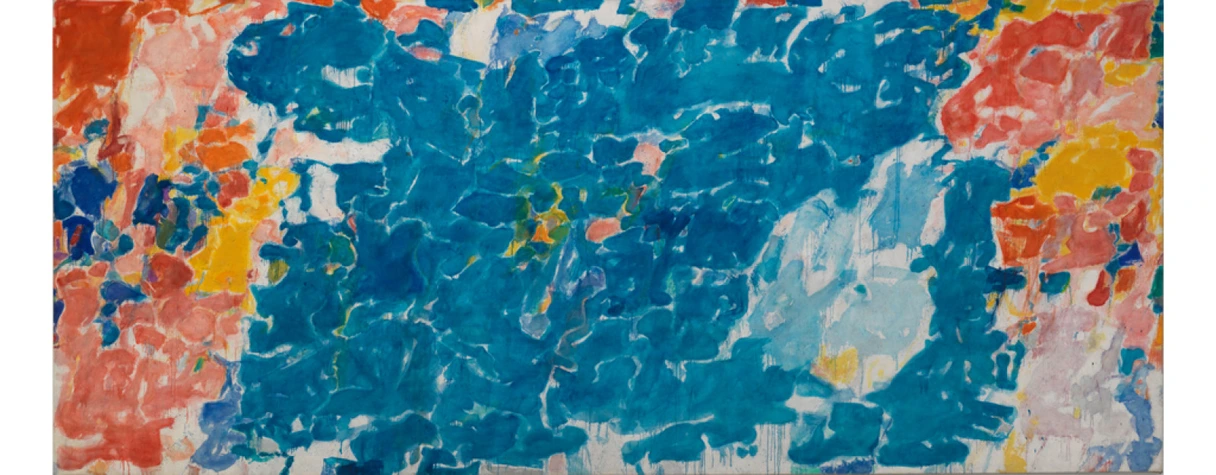
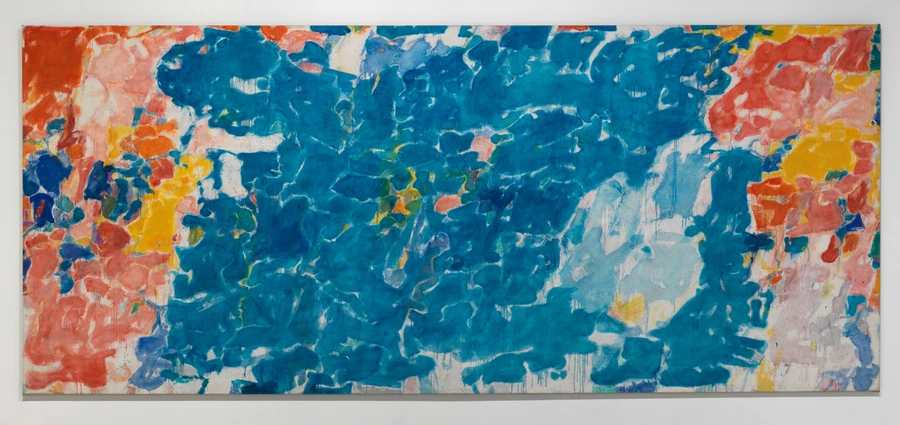
Sam Francis, « In Lovely Blueness »
On September 12, 2023, echoing Claude Monet’s Water Lilies, Musée de l’Orangerie installed Sam Francis’, very large-format painting In Lovely Blueness,loaned for three years by the National Museum of Modern Art / Centre for Industrial Creation, to which it had been given in 1977 thanks to the Scaler Foundation with Éric and Sylvie Boissonnas’ contribution.
Sam Francis arrived in Paris in 1950 and stayed there for ten years, during which his work gained recognition. This painting’s format was inspired by Monet’s Water Lilies, which he discovered in 1953 when the Museum reopened. He titled the work In Lovely Blueness, recalling a poem by Hölderlin (In Lieblicher Bläue, 1823). Blue of the sky, as the poet wrote, but also blue of the ocean according to Sam Francis, as this color reveals the lyricism of his perspective on the world.
Group of sculptures from Africa and Oceania, formerly part of the Paul Guillaume collection
The exceptional long-term loan of a group of sculptures from Africa and Oceania, formerly the Paul Guillaume Collection, by the musée du quai Branly - Jacques Chirac, along with drawings and archives, has enriched the collection’s visitor circuit.
The circulation of African sculptures in the West since the 19th century is inextricably linked to the mechanisms of colonization: removed from their original context, they are viewed by Westerners as exotic objects. They traveled the same colonial routes as raw materials, including rubber, which was needed to manufacture tires. Paul Guillaume saw rubber arriving at the auto garage where he worked in 1910. This modern place, frequented by the privileged few who owned cars, allowed him to rub shoulders with a wealthy clientele and an intellectual elite. there he met the poet and critic Guillaume Apollinaire, who was attracted by a sculpture from Gabon displayed in the window. Apollinaire was a fervent lover of African art: as early as 1909, he claimed that "The Louvre should collect certain exotic masterpieces whose appearance is no less moving than that of the fine specimens of Western statuary. "
The poet introduced the young Paul Guillaume to professionals in the market, lovers of African art, such as the Hungarian-born collector and dealer Joseph Brummer, and to the avant-garde artists gathered around the Bateau-Lavoir in Montmartre, including André Derain, Henri Matisse, and Pablo Picasso. All were fascinated by the formal aspect of these objects: they seized upon them as a new source of inspiration to overturn the codes of representation. For these artists, these objects were witnesses to preserved civilizations, which they contrasted with their daily lives as European city dwellers, which they associated, on the contrary, with modernity. The notion of primitive art used by artists and art historians in the 20th century reflects the West's lack of knowledge of these art forms, associating 19th- and 20th-century African art with an “infancy of art” that had not yet reached maturity, as opposed to modern Western art.
Having become an art dealer in 1914, Paul Guillaume broke new ground by displaying African sculptures in his gallery alongside paintings by the artists he represented, and helped to promote them to American gallery owners and collectors. He also authored important publications, such as the album Sculptures nègres, with a preface by Apollinaire, and Primitive Negro Sculpture, published by the Barnes Foundation. The use of the words “Negro” or “primitive” was considered a neutral term for African art at the beginning of the 20th century: although it was not consciously used as a derogatory term at the time, it remained intrinsically linked to a context of colonial domination.
Paul Guillaume contributed very early on to a change in the perception of these works: initially considered objects of curiosity, African sculptures were, at the beginning of the 20th century, perceived as works of art with aesthetic qualities.
Matrices Chromatiques [Chromatic Matrices], by Agnès Thurnauer
Matrices Chromatiques [Chromatic Matrices], functional sculptures designed by the artist Agnès Thurnauer, have been installed in a number of spaces in the Musée de l'Orangerie.
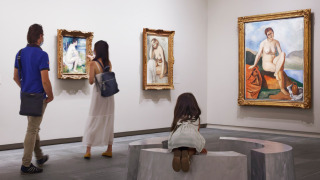
Commissioned and donated to the Centre National des Arts Plastiques through the generosity of Sophie Javary and Alain Bernard, two of the museum’s patrons, and now on long-term loan to the Orangerie, these mat aluminum bench sculptures are like a series of “water lily letters” spelling out the word "chromatiques" and taking the aura of Monet’s work to every corner of the museum.
The Chromatic Matrices gives the Musée de l’Orangerie a powerful, elegant visual signal, underlining its renovated status as a museum, now reactivated by the contemporary gaze.