
Monet, painting time
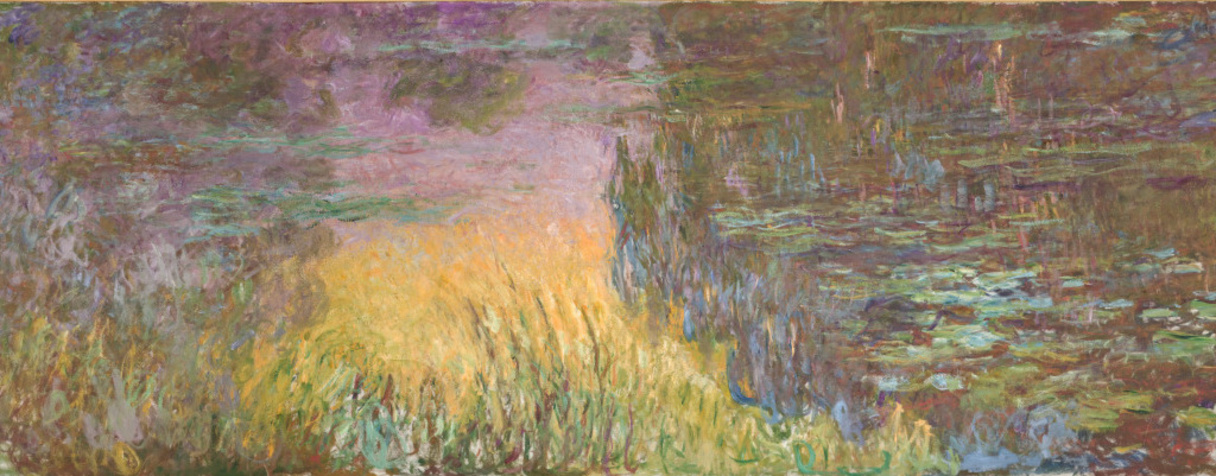
Soleil couchant, entre 1914 et 1926
Musée de l'Orangerie
© Musée de l'Orangerie, dist. RMN-Grand Palais / Patrice Schmidt
See the notice of the artwork
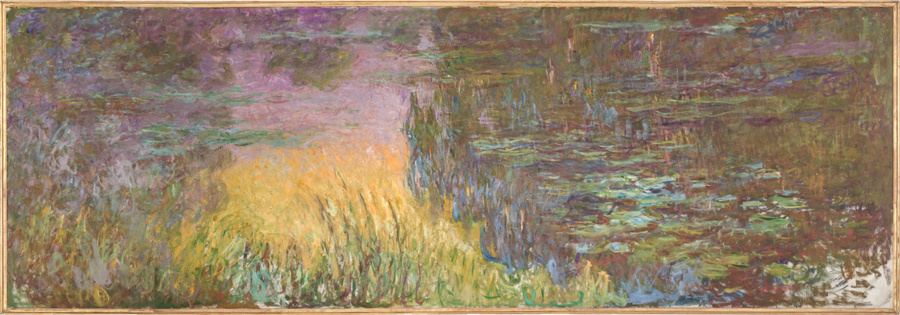
A selection of almost forty of Monet’s paintings, mostly from the Musée d’Orsay’s and Musée Marmottan Monet’s collections, along with loans from French and international public and private collections, will highlight these successive phases, with particular emphasis on the Nymphéas. From this new angle, and taking an objective approach requiring input from various research fields, the exhibition is set to reexamine a body of work whose significance, a hundred years on, is more fundamental than ever.
It is only natural that the exhibition is to be held in the Musée de l’Orangerie, which houses the imposing Nymphéas decorations. This unique venue, a true “Sistine Chapel of Impressionism” as André Masson described it in 1952, is a testimony to Monet’s last work, designed as a real environment and culminating in the Nymphéas cycle. The itinerary will reflect on the sense of acceleration of time, modernity during the artist’s impressionist period, the capture of immediacy through series, and finally the Nymphéas cycle, in search of a transcription of duration. Monet developed a form of painting that responded to the challenges and changes of his era, addressing the notion of time from a viewpoint that was both lived and felt but was also tangible through concrete signs of the transformation of urban space and landscape. The 19th century saw increasing numbers of clocks in the public space and the synchronization of measured time, along with a revolution in transport with development of the railway. Hence, echoing this 19th-century revolution in the apprehension of time, Monet’s impressionist phase might be described as the period in which he developed a form of painting that sought to capture the fleeting moment to the full.
Following the years in which the impressionist exhibitions were held, the artist began to explore the effects produced on one and the same subject at different times of day. It was in Normandy that he finally developed his famous series Les Meules [Haystacks] (1888-1891), Les peupliers au bord de l’Epte [Poplars on the Epte] (1891-1892), Matinée sur la Seine [Morning on the Seine] (1896-1897) and Cathédrale de Rouen [Rouen Cathedral](1892-1898). In these series, the painter’s depiction of the moment became an attempt to fragment time in order to better capture its
essence. In 1895, Clemenceau compared the Cathédrales de Rouen series, exhibited at the Durand-Ruel Gallery, to “a revolution without a single shot fired” (Clemenceau, “Révolution de Cathédrales”, 1895, in La Justice). In this pictorial research, Monet seems to have shared his era’s fascination with meticulous and almost scientific observation of the world around it.
In the 1890s, Monet started on a final cycle that was to occupy him until his death in 1926 – the Nymphéas. It consists of more than two hundred canvases on the same subject, and was honored by the creation of two rooms specifically designed to accommodate his large-format panels, which he gifted to France the day after the 1918 Armistice, the painter’s final work, inaugurated in 1927 a year after his death. Everything combines to provide the beholder with an immersion in the work close to “duration” in the Bergsonian sense of the term.
Monet au fil de l'eau [Monet in Real Time]
Virtual reality experience
This immersive project accompanies the “Monet, painting time” exhibition. Titled “Monet – au fil de l’eau [Monet – In Real Time], it is a virtual reality experience that takes visitors on a unique journey into the heart of the impressionist master’s work.
The twenty-minute sequence draws on the L’Obsession desNymphéas [The Water Lily Obsession] virtual reality experience produced by Lucid Realities in 2018 and presented at the Musée de l’Orangerie in 2018 and 2024.
From Argenteuil to Giverny, from the Seine to the water-lily pond, the experience whisks us away in discovery of Claude Monet’s body of work and his obsession with capturing the passage of time in the depiction of a landscape, the light effects that change depending on time of day and season: his series (Peupliers [Poplars], Matinées [Mornings], Bassins aux nymphéas [Water-Lily Ponds], Paysages d’eaux [Landscapes of Water], Ponts japonais [Japanese Bridges], Grandes decorations [Grand Decorations], etc.), the story of his house in Giverny and its pond, as well as his fight against blindness and evolution towards an almost abstract form of painting.
This virtual reality experience is provided via a standalone headset and is available in French and English.
Curatorship
Cécile Girardeau, Chief Curator, Musée de l’Orangerie, Paris
Sophie Eloy, Collections Officer, Musée de l’Orangerie, Paris
With the exceptional support of

- Monday 9.00am - 6.00pm
- Tuesday Closed
- Wednesday 9.00am - 6.00pm
- Thursday 9.00am - 6.00pm
- Friday 9.00am - 6.00pm
- Saturday 9.00am - 6.00pm
- Sunday 9.00am - 6.00pm
- Time slot full rate
- €12.50
- Time slot reduced rate
- €10
-
Enfant & Cie
-
€10
-
-18 year olds, -26 year old residents of the EEA
- Free
-
Late night*
-
€10
*Time-stamped discounted rate during the exceptional evening hours from 6:00 pm to 9:00 pm, every Friday during the exhibition period